

Message from Deputy Mayor Matt Adams | August 8, 2025
As our community collectively experienced on July 14, and multiple times before it, flash flooding is a continuing problem in parts of our area. It has the potential to uproot people from their homes, disrupt businesses, and it risks the lives of residents, guests, and first responders. We are not alone in this struggle, as other communities in our area face the risks of flooding too.
Flooding in Scotch Plains has occurred since our community’s earliest days. In fact, portions of our town were once highly attractive to agricultural use because of the ease of natural irrigation from storm runoff traveling down from the Watchung Reservation. You may notice that we are surrounded by a network of streams that lead from the Watchung Mountains at our western border. Yet, we are no longer an agricultural community, and some of the same conditions persist.
I recently discovered a news article from 50 years ago when my predecessors on the Township Council contemplated what to do about flooding and lamented the increasing frequency of storms that brought flood waters to our town. With increasingly erratic weather patterns because of climate change and the influx of new development in the region taxing some of our more dated infrastructure, the flood risk to certain parts of our town has only become more acute.
I want to take this opportunity to address for the community some of the root causes of flooding events like we saw on July 14, and also address what your governing body is doing to help mitigate the flood risk to our community.
Let me start by explaining what we saw on July 14 beyond the torrential rains that dumped a tremendous amount of rain on the area in a very short time.
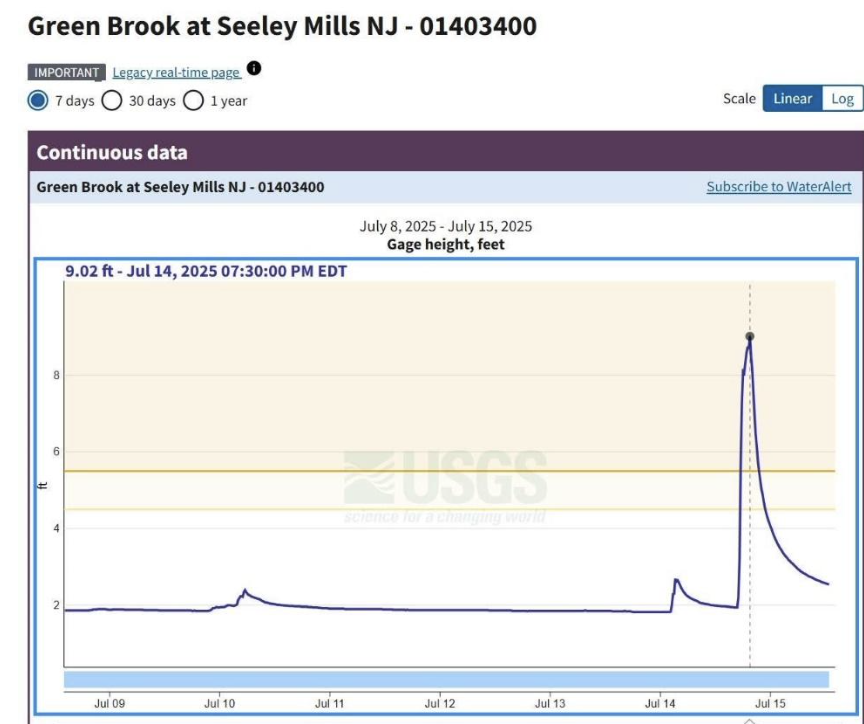
The United States Geological Service maintains flood monitors at several locations along the waterways that surround our community, including the Green Brook at Seeley’s Pond in the Watchung Reservation. During the flooding event, the gauge height there was recorded at a normal 1.94 foot level at 4:30 pm. In the span of 3 hours, or by 7:30 pm, it rose to a recorded gauge height of approaching 10 feet, nearly double flood stage.
For perspective, “action stage” is defined as a gauge height of 4.5 feet, which was reached within less than an hour after the storm began, and “flood stage,” which is defined as 5.5 feet gauge height, was reached by 5:30 pm on July 14. The y axis in the chart below charts gauge height and is plotted against time on the x axis.
Several feet over flood stage, much of that water from the Green Brook wound up coming down spillways along the reservation and into our downtown. Unlike prior flooding events that we experienced in town, however, most of the flooding that we experienced was centralized to our downtown and surrounding streets. That is due, in part, to efforts we have undertaken since the remnants of Hurricane Ida resulted in widespread flooding across multiple areas of our community in 2021.
Since Ida, the Township has worked with its partners to clear blockages along the vast network of streams and other tributaries that crisscross Scotch Plains.
Debris like tree limbs and accumulated excess soil previously prevented the flow of runoff in the area of Winding Brook Way and near the Bayberry apartments at our boarder with Clark. Those areas faired far better during the July 14 event than they did during Ida.
We have also worked with the County of Union to undertake a significant reinforcement and cleaning effort of the main spillway in our town for the Green Brook parallel to the westbound side of Route 22. Additionally, we have begun inventorying and Geographic Information System (GIS) mapping all storm sewer inlets in town to ensure that we can have a better handle on where additional stormwater infrastructure is needed and practical.
At the new Lidl grocery store site at the western gateway to Scotch Plains, the Township would not grant resolution compliance approval until Lidl agreed to update their site plans to ensure compliance with the most recent drainage and stormwater management plan requirements. Lidl ultimately agreed to revise their site plans in order to be able to move forward with applying for building permits. As with all development project approvals, the Township’s Boards, engineers, and professionals require that all development projects satisfy the most recent stormwater and NJDEP requirements. During the events of July 14, the area surrounding the future Lidl was the site of particularly bad flooding.
The stormwater system that the Township is requiring Lidl to install at its property will serve an important mitigation role in future events. Right now, the lot has no modern stormwater management infrastructure.
Yet, all of these efforts at the municipal level are not enough to prevent future flooding.
For years there has been bipartisan support for flood control along the Green Brook. The Army Corps of Engineers has devised a plan that breaks the project into three sections: the lower portion, the stony brook, and the upper basin.
Much of the allocated dollars for actual work along the Green Brook, to date, has focused on the first two areas. In Scotch Plains, we fall within the upper basin, where work has largely limited to feasibility studies. Township Officials met with the Army Corps of Engineers in the aftermath of the events of July 14, and expressed the urgent need for federal assistance while engineers from the Army Corps of Engineer toured many of the impacted sites in Scotch Plains and collected measurements and data.
The entirety of the Green Brook flood mitigation project was authorized by Congress in 1986, and work on the lower basin started in 1999. A feasibility cost sharing agreement was reached between the New Jersey Department of Environmental Protection and federal government in September 2022 which allowed for the Army Corps of Engineers to finally complete its study of the various alternatives to control flooding in the upper basin, where we sit.
The Army Corps of Engineers is scheduled to report to Congress in September of this year on its findings and recommendations. However, flood control work in the upper basin is far from a certainty. It will require significant federal dollars and political will.
When the Township Council last met publicly after the flooding, I strongly encouraged our entire NJ Congressional Delegation – Democrats and Republicans— to act swiftly to authorize whatever remedial work is recommended by the Army Corps of Engineers for the upper basin and encouraged all residents to reach out to our federal representatives as well. Mayor Josh Losardo has been in direct and frequent contact with our Congressman, Rep. Tom Kean, Jr. about this issue.
The price tag of work in other areas along the Green Brook has exceeded $1 billion, and the upper basin work will no doubt carry a similarly astronomical price tag. While we continue to devise new ways to tackle this problem at the local level, the significant dollars necessary to tackle this issue will require bipartisan collaboration across all levels of government.
We have a problem that is not isolated to Scotch Plains. Much of the root cause of the problem is in the Watchung Reservation, in an entirely different community that is not as impacted by flood events as Scotch Plains given its topography.
Along with my colleagues on the Council, we will pass a resolution at our next public meeting on August 19 seeking the support of our neighboring municipalities, the county, state, and federal governments to find a solution to the threat posed by the type of floods we saw on July 14. While there is plenty we can do to plan, prepare for, and mitigate future flooding, we cannot do it alone.
Please join me in advocating to elected officials across all levels of government and regardless of political affiliation to bring the necessary flood mitigation solutions to the people of Scotch Plains. As we reimagine and revitalize Scotch Plains, we must have a keen eye on flood resiliency. As long as I am in this position, residents of Scotch Plains have my word that this issue will continue to be at the top of my priority list.


